
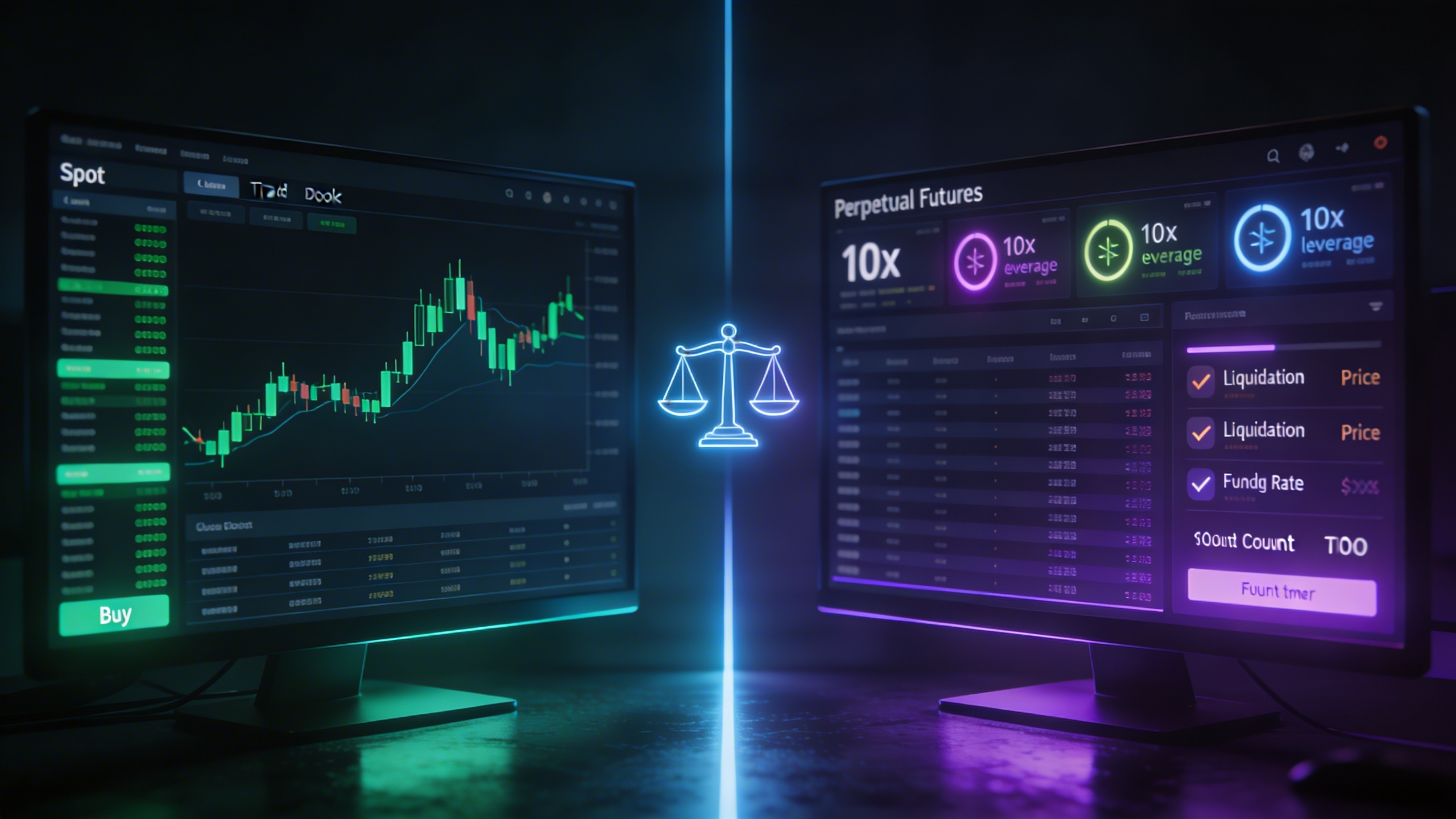
Spot vs. Futures Trading in 2026: How to Choose the Right Strategy for This Market
Bitcoin at $70K, leverage wiped out, and ETF flows surging. Learn when to use spot trading vs. perpetual futures, how to manage leverage risk, and why smart traders use both.
Bitcoin is trading at $70,000. Five months ago, it was $126,000. The drawdown wiped out $1.68 billion in leveraged positions in a single 24-hour liquidation event — 93% of them longs. Meanwhile, spot Bitcoin ETFs quietly absorbed 11,213 BTC last week alone, worth $734 million, even as prices drifted lower.
Two very different stories are playing out in the same market. Leveraged traders got destroyed. Spot buyers accumulated. And the question every trader needs to answer right now is not “where is the price going?” — it is “which tool should I be using to trade this market?”
Spot trading and futures trading are not competing strategies. They are different instruments designed for different market conditions. The traders who understand when to use each one — and how to combine them — consistently outperform those who default to one approach regardless of the environment.
This guide breaks down both strategies in the context of where the market stands today, in March 2026, and shows you exactly how to deploy them.
What Spot Trading Actually Is — And Why It Matters Now
Spot trading means buying and selling the actual cryptocurrency at the current market price. When you buy 1 BTC on a spot exchange, you own that Bitcoin. You can transfer it to a cold wallet, hold it for five years, or sell it tomorrow. There is no expiry date, no funding rate, no liquidation price.
This simplicity is its greatest strength — especially in the current environment.
Why Spot Is Dominating in March 2026
The market structure in March 2026 has shifted decisively in favor of spot buyers. Here is why:
Leverage has been flushed. Open interest across all crypto futures has fallen 43% from the January peak of $37.67 billion to approximately $21.32 billion. The February liquidation cascade — triggered by geopolitical escalation and compounded by five consecutive weeks of ETF outflows totaling $3.8 billion — eliminated the crowded leveraged positions that had built up during the October-January run.
Spot ETF flows are counter-trend accumulating. Despite Bitcoin trading 47% below its all-time high, spot Bitcoin ETFs hold $93.14 billion in AUM as of March 11, 2026. Last week, ETFs absorbed over $734 million in net inflows. This is institutional capital deploying on the spot side — not speculating with leverage, but accumulating the underlying asset.
Exchange spot inflows collapsed 95%. Spot inflows to exchanges dropped from 53,709 BTC on February 20 to just 2,879 BTC by March 9. Large holders are not selling. They are holding — or moving coins to cold storage.
Whale accumulation continues. On March 11, a single whale withdrew 2,000 BTC ($140 million) from a major exchange into cold storage. CryptoQuant’s Exchange Whale Ratio has trended downward since mid-February, confirming reduced selling pressure from large holders.
The message from the data is clear: the smart money is in spot mode. When institutional capital, whale wallets, and ETF flows all point in the same direction — spot accumulation during a drawdown — that is a structural signal, not noise.
Spot Trading Advantages
- No liquidation risk. You cannot be forced out of a position. If Bitcoin drops 20%, your spot holding drops 20% — but you still own the asset and can wait for recovery.
- No funding costs. Perpetual futures charge funding rates every 8 hours. In a volatile market, these costs add up. Spot positions carry zero holding cost.
- No time decay. Unlike options or dated futures, spot positions do not lose value simply from the passage of time.
- Direct ownership. You can move your assets to cold storage, earn staking rewards (for assets like ETH and SOL), or use them in DeFi protocols.
Spot Trading Limitations
- No leverage. You can only buy what you can afford. A $10,000 account buys $10,000 worth of Bitcoin — no more.
- Cannot profit from downside moves. In a bear market or during sharp pullbacks, spot traders can only sit and wait. There is no mechanism to profit from declining prices.
- Capital efficiency. 100% of your capital is committed to the position. There is no way to amplify returns or free up margin for other opportunities.
What Futures Trading Offers — And Where It Goes Wrong
Perpetual futures contracts let you trade the price of a cryptocurrency without owning the underlying asset. They have no expiry date, use leverage to amplify both gains and losses, and allow you to go long or short with equal ease.
In the right hands and in the right conditions, futures are a precision tool. In the wrong conditions — like the overleveraged market of January 2026 — they become a weapon that turns against the wielder.
How Perpetual Futures Work
A perpetual futures contract tracks the spot price of an asset through a mechanism called the funding rate. Every 8 hours, traders on the dominant side of the market pay a fee to traders on the opposite side:
- Positive funding rate: Longs pay shorts. This happens when the market is bullish and there are more long positions than shorts.
- Negative funding rate: Shorts pay longs. This signals bearish positioning.
As of March 11, 2026, the average perpetual swap funding rate for Bitcoin is approximately -0.003%, indicating that short sellers are paying a slight premium. This is a significant shift from the +0.51% funding rate seen before the February crash — a rate that signaled extreme long-side leverage before the cascade.
Leverage: The Double-Edged Sword
Major exchanges offer leverage ranging from 2x to 500x on perpetual contracts. The math is straightforward but unforgiving:
- 10x leverage: A 10% adverse move liquidates your position
- 20x leverage: A 5% adverse move liquidates your position
- 50x leverage: A 2% adverse move liquidates your position
- 100x leverage: A 1% adverse move liquidates your position
In the February 2026 crash, positions at 10x-25x leverage were the most heavily liquidated. The cascade was self-reinforcing: as positions were liquidated, the forced selling pushed prices lower, triggering more liquidations, which pushed prices lower still. Within 24 hours, $1.68 billion was wiped out.
Futures Trading Advantages
- Leverage amplifies returns. A 10% move on a 10x leveraged position yields 100% return on your margin. This capital efficiency is unmatched.
- Short selling capability. You can profit from falling prices — essential in bear markets or during corrections like the current one.
- Hedging. Spot holders can open short futures positions to protect against downside without selling their underlying assets.
- Capital efficiency. Trade larger positions with smaller capital, freeing up resources for other opportunities.
Futures Trading Risks
- Liquidation. The primary risk. Unlike spot, where you can weather any drawdown indefinitely, a leveraged position has a hard cutoff. Once your margin is depleted, the position is closed — often at the worst possible price.
- Funding costs. In a trending market, funding rates can significantly erode returns. During the bullish January run, long holders were paying 0.51% every 8 hours — equivalent to annualized costs exceeding 650%.
- Emotional amplification. Leverage magnifies not just financial outcomes but psychological pressure. A 5% spot drawdown feels manageable. The same 5% move on 20x leverage means you have lost your entire position. This pressure leads to poor decisions — cutting winners early, holding losers too long, or revenge trading after a loss.
- Complexity. Margin modes, liquidation prices, funding schedules, mark price vs. last price — futures require a deeper understanding of market mechanics than spot trading.
The 2026 Market: When to Use Each Strategy
The optimal approach depends on where we are in the market cycle and what the data tells you about the current environment. Here is a framework for March 2026.
Use Spot Trading When:
You are accumulating during a drawdown. Bitcoin at $70,000 is 47% below the $126,000 all-time high. If you believe in the long-term thesis — institutional adoption, ETF flows, stablecoin growth past $300 billion, the GENIUS Act providing regulatory clarity — then spot accumulation during fear is the historically optimal strategy. Every major cycle bottom has rewarded patient spot buyers.
Volatility is elevated and unpredictable. The ongoing US-Iran military conflict, shifting trade policies, and the Fear & Greed Index at 25 all signal uncertainty. In uncertain environments, the absence of liquidation risk makes spot the safer vehicle.
Leverage has recently been flushed. With open interest down 43%, the market is in a post-liquidation phase. These phases often see choppy, directionless price action before a new trend emerges. Spot positions let you ride out this consolidation without risk of being stopped out by whipsaws.
Use Futures Trading When:
A clear trend has established. Futures perform best in trending markets where you can ride momentum with leverage. The current range-bound consolidation between $65,000 and $72,000 is not ideal for leveraged trend-following.
You have a defined edge. If your strategy is based on specific technical setups — RSI divergence, MACD crossovers, Bollinger Band breakouts — futures let you express these trades with precision. The key is that each trade has a predefined entry, stop loss, and take profit before you open the position.
You are hedging a spot portfolio. If you hold significant spot Bitcoin and want to protect against further downside, a small short futures position can offset losses without requiring you to sell the underlying asset.
Funding rates create opportunity. When funding rates are extremely negative (as they are now), going long on perpetual futures is effectively subsidized — shorts are paying longs. This creates an asymmetric setup where the cost of being long is reduced or eliminated.
The Hybrid Strategy: How Smart Traders Use Both
The most effective approach is not choosing between spot and futures — it is using both strategically. Here is how professional traders structure their exposure in the current market.
Core-Satellite Model
Core position (70-80% of capital): Spot. This is your long-term accumulation position. Buy and hold in cold storage. No leverage, no funding costs, no liquidation risk. In the current environment, this position takes advantage of prices that are nearly 50% below the all-time high.
Satellite positions (20-30% of capital): Futures. These are your tactical trades. Short-term, leveraged positions based on technical setups with defined risk. Use 2-5x leverage maximum — never higher in the current volatile environment. Each trade should risk no more than 1-2% of total portfolio value.
Practical Implementation
Step 1: Build your spot core. Dollar-cost average into Bitcoin and Ethereum during fear. The Fear & Greed Index at 25 suggests we are still in a zone where accumulation has historically been rewarded. Do not try to time the exact bottom.
Step 2: Set alerts for futures entries. Use TraderSpy’s compound alerts to identify high-probability technical setups. Configure alerts that combine multiple conditions — RSI below 30 plus MACD histogram turning positive plus volume above average. When all three conditions align, you have a setup worth taking with leverage.
Step 3: Monitor smart money positioning. Before entering any futures trade, check what top traders are doing. TraderSpy’s Smart Money dashboard tracks top trader positions across Binance, Bybit, and Hyperliquid with 2-second updates. If 7 out of 10 top traders are positioned long with low leverage, that is a strong confirmation signal. If they are mixed or short-heavy, your long thesis needs more evidence.
Step 4: Use the Fear & Greed Index for position sizing. Not for direction — for size.
- Extreme Fear (0-20): Maximum spot accumulation. Conservative futures longs with 2-3x leverage.
- Fear (20-40): Continue spot DCA. Standard-size futures trades with defined risk.
- Neutral (40-60): Reduce new spot purchases. Futures only on A+ technical setups.
- Greed (60-80): Stop spot accumulation. Tighten futures stops. Consider hedging shorts.
- Extreme Greed (80-100): Take spot profits. Close leveraged longs. Position for reversal.
Step 5: Manage risk ruthlessly. Every futures position needs:
- Isolated margin mode to protect the rest of your account
- Stop loss placed at a level that invalidates your thesis — not where your margin runs out
- Take profit based on key resistance levels or a minimum 2:1 risk-reward ratio
- Maximum position size of 5% of total portfolio per trade
Funding Rates: The Hidden Edge Most Traders Ignore
Funding rates are one of the most underutilized signals in crypto trading. They reveal the market’s leverage positioning and can directly inform your strategy.
Current Funding Rate Environment (March 2026)
As of March 11, Bitcoin perpetual futures funding rates sit at approximately -0.003%. This means:
- Short sellers are paying long holders every 8 hours
- The market is net short — more traders are betting on further decline
- Being long is effectively subsidized
This is a dramatic reversal from January, when funding rates hit +0.51% — a signal that preceded the liquidation cascade. The shift from extreme positive funding (everyone long and leveraged) to slightly negative funding (shorts dominating, leverage cleared) is a structural reset.
How to Trade Funding Rates
Negative funding + technical support = asymmetric long. When funding is negative and price is at a key support level (like the $65,000-$67,000 zone Bitcoin has been defending), the risk-reward for a long position improves because you are being paid to hold it.
Extreme positive funding = reduce exposure. When funding rates exceed +0.1%, the market is over-leveraged long. This is the time to reduce position sizes, tighten stops, or take profits — not to add leverage.
Funding rate divergence across exchanges. Sometimes funding rates differ significantly between Binance, Bybit, and Hyperliquid. These divergences can signal where the next move will originate or create basis arbitrage opportunities.
TraderSpy tracks funding rates and derivatives data across all supported exchanges on the Market Insight dashboard, making it easy to spot these patterns in real time.
The Regulatory Tailwind: Why 2026 Is Different
The market environment in 2026 is fundamentally different from previous cycles because of the regulatory infrastructure now in place.
The GENIUS Act and Stablecoin Clarity
The GENIUS Act — signed into law in 2025 — created the first comprehensive regulatory framework for payment stablecoins in the United States. Stablecoin market capitalization has surpassed $300 billion, and stablecoins are no longer just crypto trading tools. They are being used for cross-border payments, treasury operations, and institutional settlement.
For traders, this matters because stablecoin clarity provides the on/off ramp infrastructure that supports both spot and futures markets. When regulations are clear and stablecoins are trusted, capital flows more freely into crypto markets — and capital flows drive price.
CME 24/7 Trading
CME Group launches 24/7 Bitcoin and Ethereum futures trading on May 29, 2026. This eliminates the CME gap — a structural inefficiency that has existed since 2017 — and brings institutional-grade derivatives into the round-the-clock crypto market.
For futures traders, this means institutional depth will be present at all hours, reducing the thin-liquidity wicks that hunt stop losses during off-hours. For the broader market, it means the arbitrage between regulated and unregulated futures venues will tighten, creating more efficient price discovery.
SEC-CFTC Coordination
On March 12, 2026, the SEC and CFTC signed a Memorandum of Understanding to coordinate crypto regulation. Both agencies are considering “innovation exemptions” that would create safe harbors for DeFi protocol trading. This is the clearest signal yet that regulated and decentralized derivatives markets are converging.
Building Your Trading System for the Current Market
Here is a complete framework for deploying both spot and futures in the March 2026 environment.
Daily Checklist
-
Check the Fear & Greed Index on TraderSpy’s Market Insight dashboard. Current reading: 25 (Fear). This supports continued spot accumulation and conservative leveraged longs.
-
Review funding rates. Negative funding confirms short-heavy positioning. Look for long setups that benefit from funding subsidies.
-
Monitor Smart Money positioning. Check what top traders are doing on the Smart Money dashboard. Note their direction, leverage level, and whether they are adding or reducing positions.
-
Scan for technical setups. Use compound alerts to identify RSI divergence, MACD crossovers, or Bollinger Band squeezes on your primary pairs (BTCUSDT, ETHUSDT, SOLUSDT).
-
Check derivatives data. Open interest changes, liquidation levels, and whale exchange flows all provide context for whether the current range will hold or break.
Weekly Review
- Spot accumulation progress. How much have you accumulated this week? Are you on track with your DCA plan?
- Futures P&L. What was your win rate? Average risk-reward? Did you follow your rules?
- ETF flow trends. Are institutional flows supporting or contradicting your thesis?
- Macro calendar. Upcoming FOMC, CPI, or geopolitical developments that could trigger volatility?
The Bottom Line: Spot and Futures Are Not an Either-Or Choice
The traders who lost $1.68 billion in the February liquidation did not lose because futures are inherently bad. They lost because they used the wrong tool for the wrong conditions — maximum leverage in an overleveraged market with deteriorating macro fundamentals and five weeks of sustained ETF outflows.
The traders who accumulated $734 million in spot Bitcoin via ETFs last week did not succeed because spot is inherently good. They succeeded because they recognized the market conditions favored accumulation over speculation.
The edge in 2026 is not in choosing one strategy. It is in knowing when to deploy each one:
- Spot for accumulation during fear, drawdowns, and structural resets
- Futures for precision trades during established trends, at key technical levels, and when funding rates create asymmetric opportunities
- Both together for a core-satellite portfolio that captures long-term upside while generating tactical alpha
The market has given you a reset. Leverage is flushed. Fear is elevated. Institutions are accumulating. Funding rates are subsidizing longs. The infrastructure — from spot ETFs to 24/7 CME futures to stablecoin regulatory clarity — has never been stronger.
The question is not whether opportunity exists. It is whether you have the tools and the discipline to capture it.
TraderSpy gives you the complete toolkit: Smart Money tracking to see what top traders are doing, compound alerts to catch technical setups across 100+ pairs, a Market Insight dashboard with Fear & Greed, funding rates, and derivatives data — and auto-trading with built-in risk controls that execute your strategy even when you are not watching the screen.
Getting Started
- Open the Market Insight dashboard on TraderSpy and review the Fear & Greed Index, funding rates, and derivatives data.
- Follow 5-10 top traders on the Smart Money dashboard to understand institutional positioning.
- Set compound alerts for RSI divergence + MACD crossover on BTCUSDT and ETHUSDT.
- Begin spot accumulation using dollar-cost averaging while prices remain in the fear zone.
- Take selective futures trades only when your alerts trigger and smart money confirms the direction.
- Use isolated margin and set stop losses on every leveraged position — no exceptions.
The market rewards preparation, not prediction. Build your system. Follow the data. And use the right tool for the right conditions.