
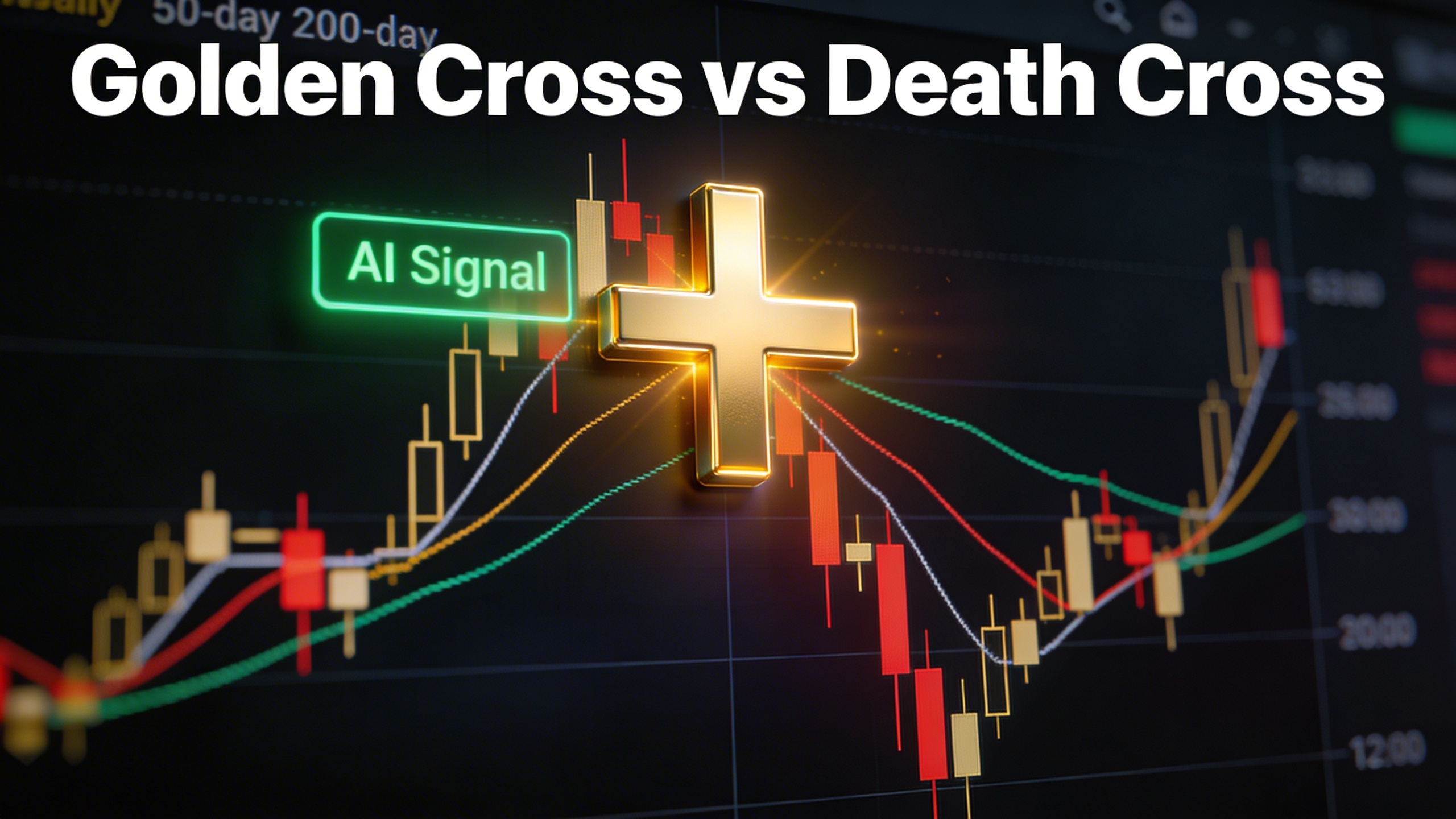
Golden Cross vs Death Cross: The AI Signals That Called Bitcoin's 2026 Reversal
Golden cross and death cross EMA crossovers are among the most powerful trend signals in crypto. Learn how AI-powered multi-indicator alerts turn these lagging signals into actionable trades.
On November 18, 2025, Bitcoin’s 50-day EMA crossed below its 200-day EMA. The death cross had arrived. Within six weeks, BTC dropped from $91,000 to below $78,000 — a 14% decline that liquidated over $2.3 billion in leveraged long positions.
Then, on March 15, 2026, the opposite happened. Bitcoin reclaimed the 200-day EMA and printed a confirmed golden cross setup. The price had already rallied 18% from its February low by the time the crossover completed. Most traders saw the signal. Very few were positioned for it.
This is the fundamental problem with moving average crossovers: they are lagging indicators. By the time the golden cross or death cross appears on your chart, the move is already underway. The crossover confirms what happened — it does not predict what will happen next.
But what if you could detect the conditions that precede a crossover — the convergence, the momentum shift, the volume confirmation — and get alerted before the cross completes? That is exactly what AI-powered compound signals do. And in 2026, they are no longer theoretical. They are live, automated, and generating alerts in real time.
This guide covers everything you need to know about golden crosses and death crosses, why they matter in crypto, how to avoid their biggest traps, and how to build an AI alert system that catches the move before the crossover shows up on your chart.
What Is a Golden Cross?
A golden cross occurs when a short-term moving average crosses above a long-term moving average. In the most commonly used configuration:
- Short-term MA: 50-day EMA (or SMA)
- Long-term MA: 200-day EMA (or SMA)
When the 50-day crosses above the 200-day, it signals that recent price momentum has shifted bullish relative to the longer-term trend. The market’s short-term trajectory is now outpacing its long-term average — a structural shift that has historically preceded sustained rallies.
Three Phases of a Golden Cross
- Decline and bottoming: Price is below both moving averages. The short-term MA is below the long-term MA. The downtrend is intact.
- Convergence: The short-term MA begins rising and approaches the long-term MA from below. The gap narrows. Momentum is shifting but has not confirmed yet.
- Crossover and confirmation: The 50-day crosses above the 200-day. If accompanied by rising volume and momentum indicators, the golden cross is confirmed.
Golden Cross Track Record in Bitcoin
- April 2020: Golden cross at ~$7,200. Bitcoin rallied to $64,000 over the next 12 months — a 789% gain.
- September 2021: Golden cross at ~$45,000. BTC briefly pushed to $69,000 before reversing — a false signal that caught many off guard.
- October 2023: Golden cross at ~$28,500. BTC rallied to $73,000 within 5 months.
- March 2026: Golden cross setup forming as BTC reclaims the 200-day EMA. Still developing.
The signal works — but not every time. The September 2021 example is a critical reminder that golden crosses can fail, especially when they occur during distribution phases or when momentum indicators diverge from price action.
What Is a Death Cross?
A death cross is the inverse: the 50-day EMA crosses below the 200-day EMA. This signals that short-term momentum has turned bearish relative to the long-term trend.
Three Phases of a Death Cross
- Rally and topping: Price is above both MAs. The short-term MA is above the long-term MA. The uptrend is intact.
- Convergence: The short-term MA begins falling and approaches the long-term MA from above. Momentum is fading.
- Crossover and confirmation: The 50-day crosses below the 200-day. If accompanied by rising volume and bearish momentum indicators, the death cross is confirmed.
Death Cross Track Record in Bitcoin
- March 2020: Death cross formed just before the COVID crash. BTC dropped from $9,100 to $3,800 — a 58% decline.
- June 2022: Death cross at ~$31,000. BTC continued falling to $15,500 over the next 5 months — a 50% decline.
- November 2025: Death cross at ~$91,000. BTC dropped to $78,000 by January 2026 — a 14% decline before recovering.
In two out of three of these examples, the death cross preceded a significant continued decline. But the November 2025 signal was followed by a recovery, making it a partially false signal for anyone who sold and stayed out.
EMA vs SMA: Which Should You Use?
Both Exponential Moving Averages (EMA) and Simple Moving Averages (SMA) are used for crossover strategies. The difference matters:
| Feature | EMA | SMA |
|---|---|---|
| Weighting | More weight to recent prices | Equal weight to all prices |
| Responsiveness | Faster reaction to price changes | Slower, smoother reaction |
| Signal timing | Earlier signals | Later signals |
| False signal rate | Higher | Lower |
| Best for | Active traders, shorter timeframes | Swing traders, daily charts |
For crypto trading, EMA is generally preferred because:
- Crypto markets move fast. The EMA’s responsiveness captures trend shifts days before the SMA.
- The 24/7 nature of crypto means there is no gap risk. EMAs reflect continuous price action accurately.
- In the November 2025 death cross, the EMA signaled 4 days before the SMA crossover — enough time to position before the sharpest part of the decline.
TraderSpy uses EMA-based crossover calculations in its AI presets, specifically the 50/200 EMA configuration for daily golden cross and death cross detection, and the 9/21 EMA configuration for shorter-term trend signals.
The Lag Problem — Why Most Traders Miss the Move
Here is the uncomfortable truth about moving average crossovers: the market moves 10-15 candles before the crossover completes.
This is not a flaw — it is a mathematical certainty. Moving averages are calculated from past prices. The 50-day EMA needs 50 days of data. By the time it crosses the 200-day, the price trend has already been in motion for weeks.
In November 2025:
- Bitcoin peaked at $99,500 on November 4th
- The 50-day EMA started declining around November 8th
- The actual death cross did not complete until November 18th
- By then, BTC had already dropped 8% from the peak
In the March 2026 recovery:
- Bitcoin bottomed at $74,800 on February 3rd
- The 50-day EMA started rising around February 20th
- The golden cross setup did not form until mid-March
- By then, BTC had already rallied 18% from the bottom
If you waited for the crossover to trade, you missed the best part of the move. This is why professional traders do not trade crossovers in isolation. They use crossovers as confirmation of a trend they have already identified using leading indicators.
The AI Solution: Compound Signals That Beat the Lag
This is where AI-powered multi-indicator alerts change the game. Instead of waiting for the crossover to complete, you set up compound conditions that detect the convergence phase — the period when the MAs are approaching each other and momentum is already shifting.
How TraderSpy’s AI Presets Work
TraderSpy has 26 pre-configured AI alert presets that evaluate conditions across all supported pairs every 5-10 seconds. Two of the most powerful presets are specifically designed for crossover detection:
Daily Golden Cross + RSI (High Importance)
- Trigger: EMA 50/200 bullish crossover on the daily chart + RSI above 50
- Signal strength: Very Strong
- Cooldown: 24 hours (to prevent repeat alerts)
- Why it works: The RSI confirmation filter eliminates false golden crosses that occur during distribution phases (like September 2021, when RSI was already declining)
Daily Death Cross + RSI (High Importance)
- Trigger: EMA 50/200 bearish crossover on the daily chart + RSI below 50
- Signal strength: Very Strong
- Cooldown: 24 hours
- Why it works: The RSI filter prevents false death crosses during accumulation phases where smart money is buying the dip
But the real edge comes from the shorter-timeframe presets that detect the approach to a crossover:
Trend Breakout Buy: ADX + EMA + Volume (1H)
- Trigger: ADX above 25 (confirming a trend is developing) + EMA 9/21 bullish crossover + Volume spike at 2x average
- This fires days or weeks before the daily golden cross completes
- It catches the momentum shift that eventually produces the golden cross
Early Momentum Shift: MACD + RSI + ADX (4H)
- Trigger: MACD histogram crosses above zero + RSI above 50 + ADX above 25
- Detects the exact moment momentum flips from bearish to bullish on the 4H chart
- In the February 2026 recovery, this preset fired on February 5th — two days after the bottom and six weeks before the daily golden cross formed
The Multi-Timeframe Advantage
The most powerful approach is multi-timeframe analysis, which TraderSpy handles automatically:
Multi-TF Buy: 4H Oversold + 1H Bullish Momentum
- Evaluates: RSI below 30 on the 4H chart + MACD bullish crossover on the 1H chart + ADX above 25 on the 4H chart
- Signal strength: Very Strong
- This preset detects when the market is oversold on the higher timeframe while bullish momentum is already building on the lower timeframe — the exact setup that precedes major reversals and eventual golden crosses
Building Your Golden Cross / Death Cross Alert System
Here is a complete system for trading EMA crossovers using AI-powered alerts on TraderSpy.
Layer 1: Early Warning (Days/Weeks Before Crossover)
Set up the following alerts to catch the convergence phase:
- EMA 9/21 crossover on 4H chart: When the fast EMA crosses the slow EMA on the 4-hour chart, a trend shift is developing. This typically fires 5-15 days before the daily 50/200 crossover.
- MACD histogram zero cross on 4H: When the MACD histogram crosses zero, momentum has shifted. Combined with RSI and ADX confirmation, this is one of the earliest reliable signals.
- ADX rising above 25 on daily: When ADX moves above 25, a new trend is strengthening. This is a necessary condition for any valid crossover.
Layer 2: Confirmation (Days Before Crossover)
- RSI crossing above/below 50 on daily chart: The 50-level is the dividing line between bullish and bearish momentum. When RSI crosses 50 in the direction of the developing crossover, the probability of a genuine (not false) crossover increases significantly.
- Volume surge on the breakout candle: A 1.5-2x volume spike during the trend shift confirms institutional participation.
Layer 3: Execution (At or Near Crossover)
- Daily Golden Cross + RSI preset: The confirmed crossover signal with RSI validation. This is your highest-conviction entry.
- Daily Death Cross + RSI preset: The confirmed bearish crossover. Use this for exits, shorts, or risk reduction.
Layer 4: Risk Management
- Price closing below the 200-day EMA after a golden cross: This invalidates the bullish signal. Set an exit alert.
- Price closing above the 200-day EMA after a death cross: This invalidates the bearish signal. Cover shorts or re-enter longs.
Five Common EMA Crossover Mistakes
Mistake 1: Trading the Crossover Alone
The crossover is a confirmation signal, not a prediction. Trading it alone means entering after the move has already started. Always combine with leading indicators (RSI, MACD, volume, ADX) to enter earlier and with more confidence.
Mistake 2: Ignoring the ADX
Not all crossovers are created equal. A golden cross in a market with ADX below 20 (no trend) is far less reliable than one where ADX is above 25 (trend confirmed). The ADX reading at the time of crossover is one of the strongest filters for separating genuine signals from noise.
Mistake 3: Using the Wrong Timeframe
Golden crosses and death crosses on the 5-minute chart are meaningless noise. On the daily chart, they occur 1-3 times per year and carry significant weight. On the 4-hour chart, they are useful for swing trading. Match your timeframe to your trading style:
- Daily: Position trading, portfolio management (1-3 signals/year)
- 4H: Swing trading (5-10 signals/year)
- 1H: Day trading (frequent, requires additional filters)
Mistake 4: Ignoring Volume
A golden cross without a volume surge is suspicious. Genuine trend reversals are backed by increasing volume — it confirms that institutional money is flowing in the direction of the new trend. Low-volume crossovers are often fakeouts that reverse within days.
Mistake 5: Not Using Multi-Timeframe Analysis
The biggest edge in crossover trading comes from aligning multiple timeframes. If the 4H chart shows a bullish EMA crossover, the daily chart shows RSI crossing above 50, and the 1H chart shows MACD bullish momentum — the confluence of signals across timeframes dramatically increases the probability of success.
TraderSpy’s multi-timeframe AI presets handle this automatically, evaluating conditions across different timeframes simultaneously and only alerting when multi-timeframe confluence is confirmed.
EMA Crossover Settings for Different Trading Styles
Position Traders (Weekly/Daily)
- EMA pair: 50/200
- Confirmation: RSI above/below 50 + ADX above 25
- Timeframe: Daily chart
- Signals per year: 1-3 on major pairs
- Average move captured: 15-40% per signal
- Best for: Portfolio-level decisions, trend following
Swing Traders (Daily/4H)
- EMA pair: 21/55 or 9/21
- Confirmation: MACD histogram direction + volume spike
- Timeframe: 4H chart
- Signals per year: 5-15 on major pairs
- Average move captured: 5-15% per signal
- Best for: Multi-day trades, capturing intermediate trends
Day Traders (4H/1H)
- EMA pair: 9/21
- Confirmation: RSI momentum + ADX above 20 + volume
- Timeframe: 1H chart
- Signals per session: Multiple per week
- Average move captured: 2-5% per signal
- Best for: Intraday momentum trades
The February 2026 Case Study: How AI Signals Called the Bottom
Let us walk through exactly how the AI signal system performed during Bitcoin’s February 2026 correction and recovery.
The Setup
- January 15, 2026: Bitcoin trading at $95,000. Death cross from November 2025 still active.
- January 28, 2026: BTC drops below $82,000. Panic selling intensifies. Funding rates go extremely negative.
- February 3, 2026: BTC hits $74,800 — the cycle low.
What the AI Signals Detected
February 3 (Day of the bottom):
- “Double Oversold: RSI + MFI” preset fired on BTCUSDT. RSI hit 22 on the 4H chart while MFI dropped below 15. Signal strength: Very Strong.
- This is a classic capitulation signal — both price momentum and money flow confirmed extreme oversold conditions.
February 5 (Early recovery):
- “Early Momentum Shift: MACD + RSI + ADX” preset fired on the 4H chart. MACD histogram crossed above zero, RSI moved above 50, and ADX rose above 25.
- BTC was at $78,500 — already 5% above the bottom but still 18% below the November high.
February 12 (Trend confirmation):
- “Trend Breakout Buy: ADX + EMA + Volume” preset fired on the 1H chart. The 9/21 EMA bullish crossover completed with 2.4x volume.
- BTC was at $83,200 — the intermediate trend had shifted bullish.
March 15 (Golden cross):
- “Daily Golden Cross + RSI” preset fired. The 50/200 EMA bullish crossover completed on the daily chart with RSI at 58.
- BTC was at $88,500 — already 18% above the bottom.
The Key Insight
Traders who only used the golden cross entered at $88,500. Traders who used the multi-layer AI signal system entered between $74,800 and $83,200 — capturing an additional 6-18% of the move that the crossover alone would have missed.
This is the difference between using a lagging confirmation signal and using an intelligent system that detects the conditions that produce the crossover.
Why EMA Crossovers Matter More in Crypto
Crypto has characteristics that make EMA crossovers particularly significant:
- 24/7 markets: No gaps, no pre-market. EMAs reflect continuous price action, making crossovers more reliable than in traditional markets where gaps can distort the calculation.
- High leverage: When a death cross forms, it triggers stop losses and liquidations on leveraged long positions, creating cascading sell pressure that amplifies the move. The November 2025 death cross triggered $2.3 billion in liquidations.
- Retail-heavy market: Most retail traders use moving average crossovers. When a golden cross forms, the influx of buying from retail traders who follow the signal creates a self-fulfilling prophecy effect.
- Correlated assets: When BTC prints a golden cross, altcoins typically follow within days. A single detection on BTC can generate trading opportunities across 20+ pairs.
TraderSpy monitors all of these dynamics in real time. With 26 AI-powered presets, compound multi-indicator alerts, 5-10 second evaluation cycles, multi-timeframe analysis, and real-time smart money tracking, you get alerted at every stage of the crossover lifecycle — from the early momentum shift to the confirmed crossover to the exit warning.
Getting Started
- Understand the current market regime: Is Bitcoin above or below the 200-day EMA? This determines whether golden cross or death cross setups are likely.
- Enable AI presets on TraderSpy: Activate the “Daily Golden Cross + RSI” and “Daily Death Cross + RSI” presets for your most-traded pairs.
- Add early warning presets: Enable the “Trend Breakout” and “Early Momentum Shift” presets to catch the move before the daily crossover forms.
- Set up multi-timeframe alerts: Use the “Multi-TF Buy” and “Multi-TF Sell” presets that combine 4H and 1H signals for the earliest high-probability entries.
- Monitor smart money positioning: Check the Smart Money dashboard during convergence phases to see if top traders are already positioning for the crossover.
- Never trade the crossover alone: Always require at least one additional confirmation — RSI direction, volume spike, or ADX trend strength — before entering a position.
The next golden cross or death cross is forming right now. The 50-day and 200-day EMAs are always converging or diverging. The question is not whether it will happen — it is whether you will catch the move at the beginning, or chase it after the crossover confirms what the AI signals already told you weeks ago.