
Crypto Options Expiry: How $8.7B Impacts Futures Trading
Bitcoin and Ethereum options worth $8.7 billion just expired. Learn how options expiry drives crypto futures volatility and how to trade it.
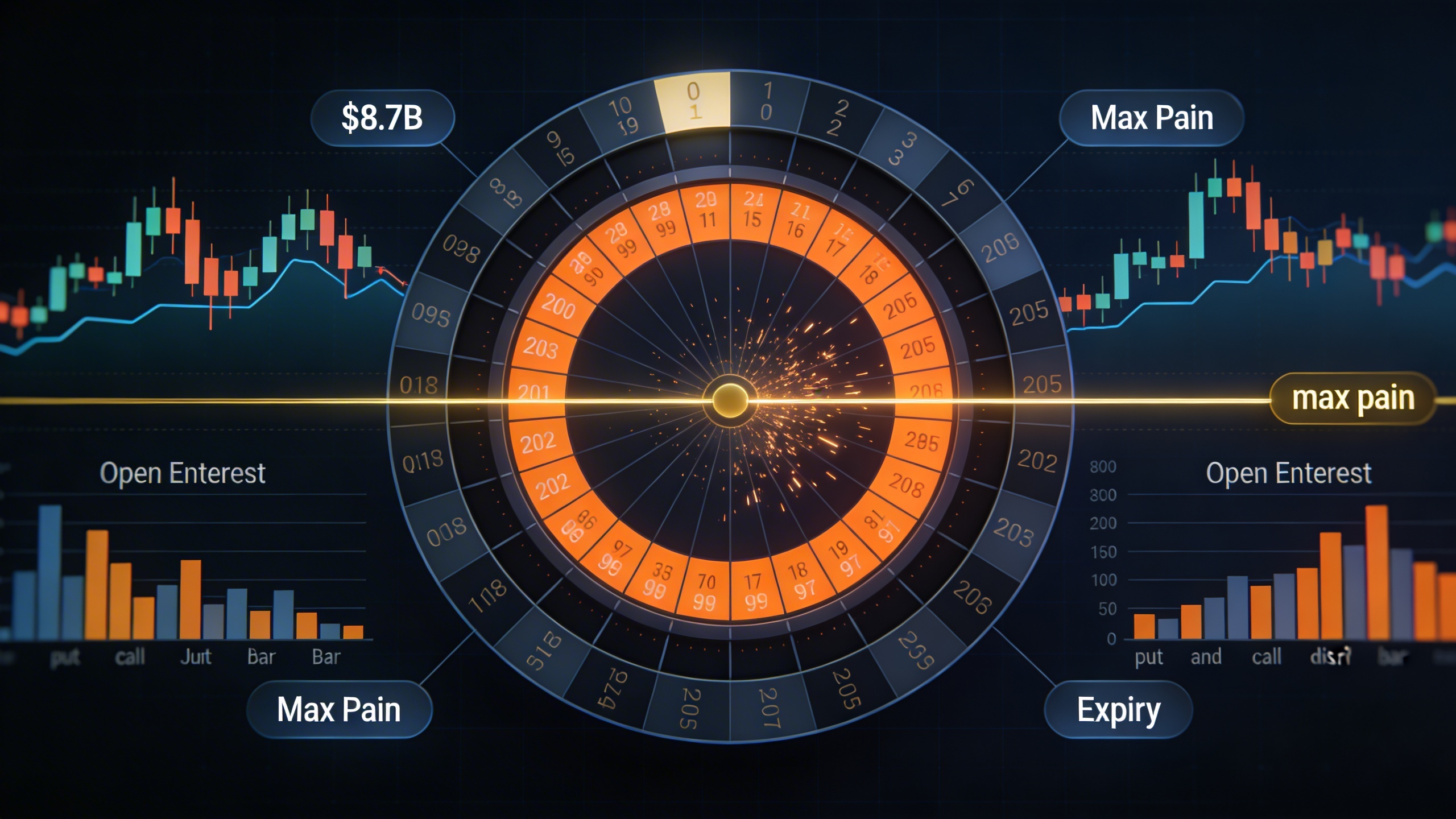
On February 27, approximately $8.7 billion in Bitcoin and Ethereum options contracts expired on Deribit — $7.49 billion in BTC options and $886 million in ETH options. In the hours surrounding the settlement, Bitcoin whipsawed from $68,000 to $70,000 and back below $65,500. This was not random volatility. It was the predictable result of massive derivatives positioning unwinding simultaneously.
Options expiry events are some of the most predictable volatility catalysts in crypto. They happen on a fixed schedule, the positioning data is publicly available, and the mechanics are well understood. Yet most futures traders ignore them entirely — and pay the price in unexpected liquidations and missed opportunities.
What Happens During Options Expiry
Crypto options on Deribit — which handles over 85% of all crypto options volume — are European-style and cash-settled. This means they can only be exercised at expiration, and no actual Bitcoin or Ethereum changes hands. Instead, profit and loss are settled in cash.
Here is why this matters for futures traders:
The Pinning Effect
In the days leading up to a major expiry, prices tend to gravitate toward the max pain price — the level where the largest number of options contracts expire worthless, causing maximum financial loss for options buyers and maximum gain for options sellers (market makers).
For the February expiry, the max pain for BTC was approximately $68,000. Bitcoin touched $70,000 on February 26, then fell back to precisely the $67,000-$68,000 range by expiry. This gravitational pull is not a coincidence — it is the result of dealer hedging.
Dealer Hedging Mechanics
Market makers who sell options must hedge their exposure by trading the underlying asset (or perpetual futures). As expiry approaches:
- Above max pain: Dealers sell BTC/short futures to hedge call options, pushing price down
- Below max pain: Dealers buy BTC/long futures to hedge put options, pushing price up
- Near max pain: Hedging activity decreases, volatility drops temporarily
This creates a predictable pre-expiry pattern: volatility compresses, price gravitates toward max pain, and then — immediately after settlement — the hedging pressure vanishes and the market moves freely again, often producing sharp directional moves.
The Post-Expiry Volatility Explosion
The most important moment for futures traders is not the expiry itself — it is the 24-48 hours after. Once billions in options settle, the hedging flows that were suppressing movement disappear. Open interest resets. New positions are established. And the market, freed from the gravitational pull of max pain, often makes its most significant directional move of the month.
After the January 2026 expiry ($2.2 billion), Bitcoin rallied 8% in three days. After the late February expiry ($8.7 billion), the market is now entering that same post-expiry window.
The Options Expiry Calendar Every Futures Trader Needs
Deribit options expire on the following schedule:
- Daily: Small contracts, minimal market impact
- Weekly (Fridays): Moderate open interest, noticeable but manageable volatility
- Monthly (last Friday): Significant open interest, strong pinning and post-expiry moves
- Quarterly (March, June, September, December): Massive open interest, the largest volatility events of the year
The February 27 expiry was a monthly event. The next major event is the March quarterly expiry — which historically produces the largest options-driven moves of Q1. Quarterly expiries routinely see $10-15 billion in total notional value, making them critical dates for any futures trader.
How Options Expiry Impacts Your Futures Positions
If you trade crypto futures without tracking options expiry, you are exposed to three specific risks:
Risk 1: Pre-Expiry Liquidation Traps
In the 3-5 days before a major expiry, the pinning effect creates false breakouts and breakdowns. Price will push above resistance or below support, triggering stop losses and liquidations, then reverse back toward max pain. These are not real trend moves — they are hedging flows creating traps.
During the February expiry week, Bitcoin broke above $70,000 briefly — triggering short liquidations — then dropped below $65,500 — triggering long liquidations. Both groups of leveraged traders were flushed by dealer hedging, not genuine supply and demand.
Risk 2: Post-Expiry Directional Surprise
The first 24-48 hours after expiry often produce the strongest directional move of the month. If you are positioned wrong or overleveraged heading into this window, the move can be devastating. If you are positioned correctly with the right information, it can be one of your most profitable trades.
Risk 3: Volatility Crush and Expansion
Options expiry creates a volatility cycle: compression before → explosion after. If your alerts are calibrated for normal volatility, they may either trigger too early (during compression) or miss the move entirely (during expansion).
Trading the Options Expiry Cycle
Here is a practical framework for futures traders:
Phase 1: Pre-Expiry (5-2 Days Before)
Goal: Avoid traps and identify the max pain level.
Check the open interest distribution and max pain price on options analytics platforms. Then look at TraderSpy’s Market Insight dashboard for derivatives data and sentiment context.
Action: Reduce leverage to 2-3x maximum. Widen stops to account for pinning volatility. Do not chase breakouts or breakdowns near max pain — they are likely traps.
Phase 2: Expiry Day (Settlement Day)
Goal: Gather intelligence for the post-expiry move.
This is a data collection day, not a trading day. Monitor:
- Funding rates: Are they negative (bearish) or positive (bullish)?
- Smart money positioning: What are top traders doing on Binance, Bybit, and Hyperliquid?
- Fear and Greed: Where is sentiment sitting?
TraderSpy’s Smart Money dashboard shows you the actual futures positions of top traders with 2-second updates — their direction, leverage, entry price, and unrealized PnL. On expiry day, watch for top traders establishing new positions. Their post-expiry positioning tells you where they expect the freed market to go.
Phase 3: Post-Expiry (1-2 Days After)
Goal: Capture the directional move with compound confirmation.
This is your trading window. The hedging flows are gone. Open interest has reset. The market is ready to move. Set compound alerts on TraderSpy combining:
- RSI + MACD crossover for momentum direction
- Bollinger Band breakout for volatility expansion confirmation
- Volume spike for participation confirmation
- EMA cross for trend direction
When the compound alert fires and Smart Money confirms the direction, enter with disciplined leverage (3-5x) in the direction of the move. The post-expiry window typically produces 3-8% moves on BTC within 48 hours — and often more on altcoins like ETHUSDT and SOLUSDT.
Phase 4: Profit Management
Take partial profits at the first significant resistance/support level. Trail the remaining position with a 2% trailing stop. Monitor funding rates — when they reach extremes, the post-expiry momentum is exhausting and a reversal becomes likely.
What Most Traders Get Wrong
Mistake 1: Trading the pinning zone. The 3-5 days before expiry are the most dangerous for leveraged traders. The market is moving on hedging flows, not on genuine supply and demand. Most breakouts fail. Most breakdowns reverse. If you must trade pre-expiry, use minimal leverage and expect mean reversion toward max pain.
Mistake 2: Ignoring the calendar. Options expiry dates are known months in advance. There is zero excuse for being caught off-guard by expiry-driven volatility. Mark the monthly and quarterly dates. Adjust your strategy accordingly.
Mistake 3: Missing the post-expiry window. The 24-48 hours after a major expiry are some of the highest-probability trading opportunities of the month. Yet most retail traders are either licking their wounds from pre-expiry liquidations or have stepped away from the screen entirely. The traders who show up prepared — with smart money data, compound alerts, and market intelligence — capture the move.
The March Quarterly Expiry: What to Watch
The next major event is the March 2026 quarterly expiry, expected to be one of the largest in crypto history given current open interest levels. Here is what makes it significant:
- Quarterly expiries attract the largest open interest concentrations
- March is historically the most volatile Q1 month for crypto
- Current macro uncertainty (tariffs, Fed policy, Middle East tensions) adds fuel to post-expiry moves
- Institutional positioning through BTC and ETH ETF options adds a new dimension to the hedging flow dynamics
Start preparing now. Monitor the open interest buildup. Track where max pain settles. And when expiry day arrives, open the Smart Money dashboard on TraderSpy and watch where top traders position for the post-expiry move.
The Key Takeaway
Options expiry is not a side note in crypto markets — it is one of the most powerful and predictable volatility catalysts available. The $8.7 billion February expiry just demonstrated this again: price pinned near max pain, false breakouts trapped leveraged traders on both sides, and the post-expiry window is now open for directional moves.
The traders who profit from these events are not the ones trading through the noise. They are the ones who reduce risk pre-expiry, gather intelligence on expiry day, and strike with compound confirmation in the post-expiry window.
TraderSpy gives you every tool you need: the Market Insight dashboard for derivatives data and sentiment, the Smart Money dashboard for real-time top trader positioning, and 40+ AI-powered compound alerts that fire when multiple technical conditions align simultaneously. Start with the free tier and prepare for the March quarterly expiry — the biggest options event of Q1 2026.