
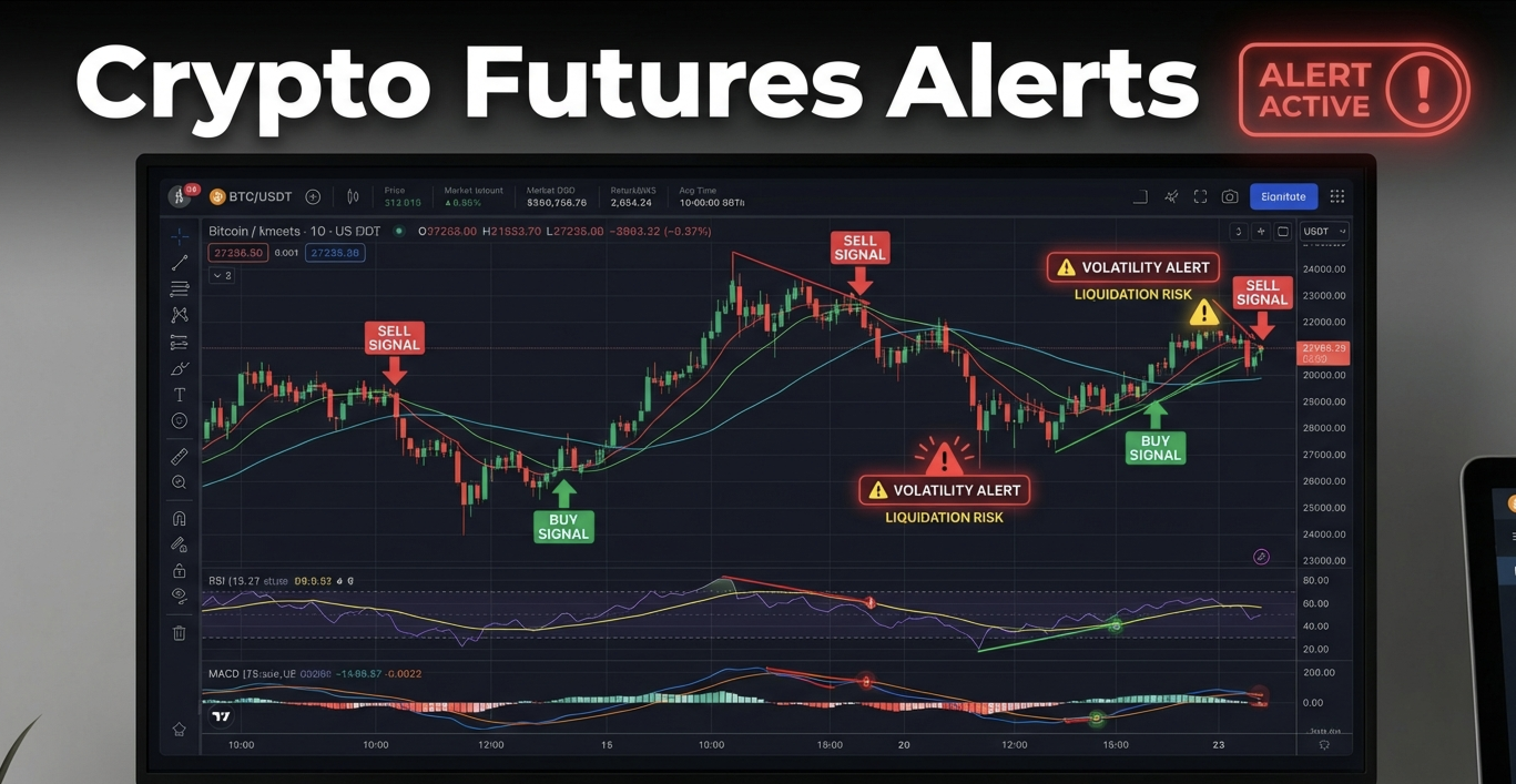
Crypto Futures Alerts: Catch Fast Signals Before Everyone Else
Learn how crypto futures alerts improve your timing, reduce noise, and help you act on high-quality trading signals in real time.
In crypto futures trading, timing is everything. A few seconds can mean the difference between catching a breakout at the perfect entry or chasing price into a losing position. That is why real-time alerts are not a luxury — they are a necessity.
The Problem with Manual Monitoring
Most traders start by watching charts manually. They sit in front of screens, switching between timeframes, scrolling through dozens of pairs, and trying to spot setups. This approach has serious limitations:
- You cannot watch everything at once. There are 20+ major futures pairs, each with 6 timeframes.
- Fatigue leads to mistakes. After hours of staring at charts, your judgment deteriorates.
- You miss overnight moves. Crypto never sleeps, but you do.
How Alerts Change the Game
With properly configured alerts, you let the system do the watching. You define the conditions — RSI crossing 30, MACD bullish crossover, volume spike above 200% average, Bollinger Band squeeze — and the system notifies you the instant those conditions are met.
Good alerts share three qualities: they are fast, configurable, and noise-free. You should not receive 50 notifications per hour. Instead, you should get a handful of high-probability signals that match your strategy.
What Makes TraderSpy Alerts Different
TraderSpy delivers alerts that combine multiple indicators into a single signal. Instead of alerting on RSI alone, you can set compound conditions: RSI below 30 AND MACD histogram turning positive AND volume above average. This multi-layer approach dramatically reduces false signals.
Alerts are evaluated every 5 seconds across all supported coins — BTCUSDT, ETHUSDT, SOLUSDT, ADAUSDT, XRPUSDT, and more. Notifications arrive via push, in-app, or WebSocket in real time.
You can also choose from 40+ AI-powered presets that cover common setups like momentum reversals, trend continuations, and volatility breakouts — no manual configuration needed.
Best Practices for Using Alerts
- Match alerts to your strategy. Do not enable every alert. Focus on the indicators and timeframes you actually trade.
- Use compound conditions. Single-indicator alerts produce too much noise. Combine two or three for cleaner signals.
- Set the right timeframe. Scalpers use 1m–5m alerts. Swing traders use 1h–4h. Choose what fits your style.
- Act quickly but not blindly. An alert is a signal, not an order. Confirm with price action before entering.
The Bottom Line
Crypto futures alerts give you an edge that manual monitoring cannot match. They keep you informed without keeping you glued to a screen, and they ensure you never miss a high-quality setup again.