
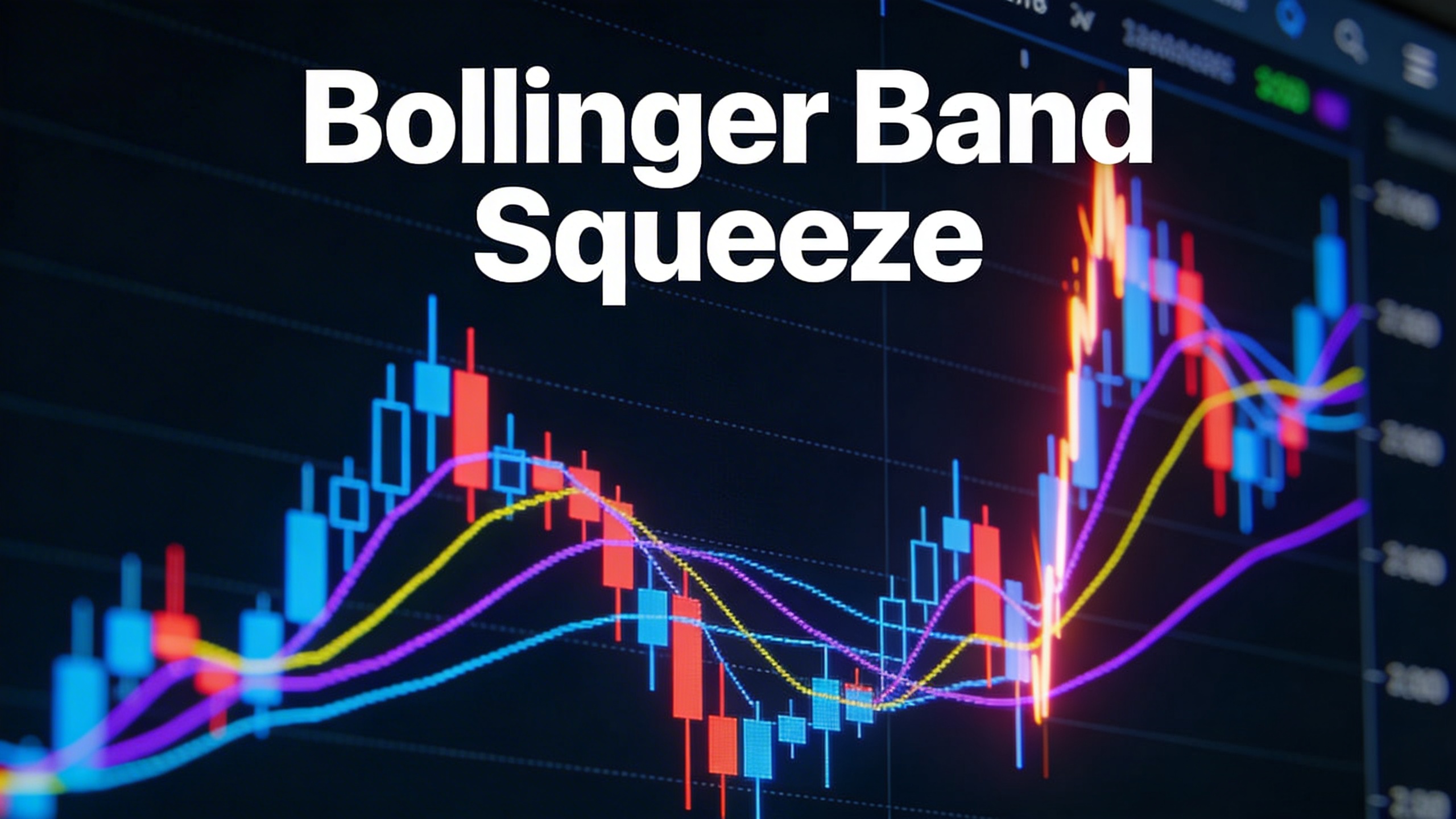
Bollinger Band Squeeze: How to Catch Explosive Breakouts Before They Happen
The Bollinger Band squeeze is one of the most reliable breakout signals in crypto futures. Learn how to identify squeezes, confirm breakout direction, and avoid false signals.
In early January 2026, Bitcoin’s Bollinger Bands compressed to their narrowest range in six months. The gap between the upper and lower bands shrank to less than $3,500 — a reading that had only been seen three times in the past two years. To most traders, it looked like a quiet, boring market. Nothing was happening.
Two weeks later, Bitcoin exploded. The breakout that followed moved price by over 25% in just four days. Traders who recognized the squeeze caught the move from the start. Everyone else was chasing candles.
This is the power of the Bollinger Band squeeze: it identifies periods of extreme compression — the calm before the storm — and gives you a framework to position before the breakout happens. In a market like crypto, where volatility is the norm, the rare moments of compression are the most profitable setups you can trade.
This guide explains exactly how Bollinger Bands work, how to identify and trade squeeze breakouts, and how to combine them with other indicators to filter false signals and maximize your edge.
What Are Bollinger Bands?
Bollinger Bands are a volatility indicator created by John Bollinger in the 1980s. They consist of three lines plotted on a price chart:
- Middle Band: A 20-period Simple Moving Average (SMA). This is the baseline — the average price over the last 20 periods.
- Upper Band: The middle band plus 2 standard deviations. This represents the upper boundary of “normal” price action.
- Lower Band: The middle band minus 2 standard deviations. This represents the lower boundary of “normal” price action.
The key insight is that the bands expand and contract based on volatility:
- Wide bands = high volatility. Price is swinging aggressively. The market is active and directional.
- Narrow bands = low volatility. Price is compressed into a tight range. The market is quiet — but building energy for the next move.
Approximately 95% of price action occurs within the bands. When price closes outside the bands, it signals an unusual move that deserves attention.
What Is a Bollinger Band Squeeze?
A squeeze occurs when the Bollinger Bands contract to an unusually narrow width. This happens when volatility drops significantly — price stops making large moves and consolidates into a tight range.
Think of a squeeze like a coiled spring. The tighter the compression, the more energy is stored. When the spring releases, the move is explosive. In market terms:
Low volatility → compression → breakout → high volatility
This cycle repeats predictably across all markets and all timeframes. Bollinger Band squeezes have preceded major moves in crypto, equities, forex, and commodities for decades. The pattern is mechanical, not speculative.
How to Measure the Squeeze
The simplest way to identify a squeeze is visually: look for periods where the upper and lower bands are closer together than usual. But for precision, use Bollinger Band Width (BBW):
BBW = (Upper Band - Lower Band) / Middle Band
When BBW drops to its lowest level in the last 120 periods (about 6 months on a daily chart), you have a confirmed squeeze. This is the setup — the breakout typically follows within 7-14 periods.
Squeeze Examples in Crypto
- October 2024: Bitcoin squeezed below $3,000 bandwidth for 11 days. The breakout launched BTC from $67,000 to $100,000+ within 8 weeks.
- March 2025: Ethereum squeezed for 9 days. The breakout pushed ETH from $3,200 to $4,800 in three weeks.
- January 2026: Bitcoin squeezed to $3,500 bandwidth — the tightest since July 2025. The subsequent crash-then-recovery moved price by over 30%.
The squeeze does not predict direction. It predicts volatility. Whether the breakout goes up or down depends on market context, momentum, and confirmation signals. That is where the strategy comes in.
The Squeeze Breakout Strategy: Step by Step
Here is a complete, actionable strategy for trading Bollinger Band squeeze breakouts in crypto futures.
Step 1: Identify the Squeeze
Scan for pairs where Bollinger Band Width has dropped to its lowest level in 120+ periods. On a daily chart, this means volatility is at a 6-month low. On a 4-hour chart, it is about a 20-day low.
With TraderSpy, you can set alerts for Bollinger Band conditions across all supported pairs — BTCUSDT, ETHUSDT, SOLUSDT, and 20+ others. The platform evaluates conditions every 5-10 seconds, so you catch the squeeze the moment it forms — not hours later.
Step 2: Wait for the Breakout Candle
The squeeze tells you a move is coming. The breakout candle tells you which direction. Wait for a decisive close outside the upper or lower band:
- Close above the upper band = bullish breakout signal
- Close below the lower band = bearish breakout signal
Critical rule: the candle must close outside the band, not just wick through it. Wicks through the bands are common and often reverse. A full candle close indicates genuine momentum.
Step 3: Confirm with Volume
A breakout without volume is suspicious. Genuine breakouts are accompanied by a volume spike — typically 150-200%+ above the recent average. Volume confirms that real money is behind the move, not just a thin-liquidity anomaly.
If the price breaks above the upper band but volume is below average, treat it as a potential false breakout and wait for additional confirmation before entering.
Step 4: Confirm with RSI and MACD
Layer additional confirmation to filter false signals:
For bullish breakouts (close above upper band):
- RSI should be above 50 and rising (confirming upward momentum)
- MACD should show a bullish crossover or be above the signal line
- ADX above 20 confirms that a trend is developing (not a range-bound fake)
For bearish breakouts (close below lower band):
- RSI should be below 50 and falling
- MACD should show a bearish crossover or be below the signal line
- ADX above 20 confirms trend development
With TraderSpy, you can build compound alerts that combine all of these conditions: “Alert me when BTCUSDT closes above the upper Bollinger Band AND volume is above 150% average AND RSI is above 50 AND MACD is bullish.” This multi-layer confirmation dramatically reduces false signals.
Step 5: Enter the Trade
Once the breakout is confirmed with volume and momentum indicators:
Long entry (bullish breakout):
- Enter on the close of the breakout candle or on a pullback to the upper band (which often acts as support after a breakout)
- Stop loss below the middle band (20 SMA)
- Take profit at 1.5x-2x risk-to-reward, or trail your stop along the middle band
Short entry (bearish breakout):
- Enter on the close of the breakout candle or on a retest of the lower band
- Stop loss above the middle band (20 SMA)
- Take profit at 1.5x-2x risk-to-reward, or trail your stop
Step 6: Manage the Trade
After entering, the middle band (20 SMA) becomes your trend guide:
- If price stays above the middle band: the bullish trend is intact. Hold your position and trail your stop loss along the middle band.
- If price closes below the middle band: momentum is fading. Tighten your stop or take partial profits.
- If the bands start contracting again: the move is losing energy. Consider exiting entirely.
The False Breakout Problem — And How to Solve It
The biggest risk with any breakout strategy is the false breakout — where price pierces through the band, triggers your entry, and then reverses. In crypto, false breakouts are especially common during low-liquidity periods (weekends, holidays, off-hours).
Why False Breakouts Happen
- Thin order books: During low liquidity, a single large order can push price through the band temporarily without genuine market conviction behind it.
- Stop hunts: Market makers and large players deliberately push price through key levels to trigger stop losses before reversing the move.
- Lack of follow-through: The initial break has momentum, but no additional buyers or sellers step in to sustain the move.
How to Filter False Breakouts
- Require a candle close, not just a wick. Wicks through the bands are noise. Closes outside the bands are signals.
- Demand volume confirmation. If volume on the breakout candle is below average, do not enter. Wait for a volume-confirmed retest.
- Check the ADX. An ADX reading below 20 means the market is range-bound, and breakouts in ranging markets have a high failure rate.
- Wait for band divergence. After a genuine breakout, the upper band should point up (bullish) while the lower band points down (bearish). If both bands are moving in the same direction, it is not a real breakout.
- Use the 1-candle rule. After the breakout candle, wait for one additional candle to close in the breakout direction before entering. This simple filter eliminates a large percentage of false signals.
Bollinger Band Settings: Which Are Best for Crypto?
The default Bollinger Band settings (20 SMA, 2 standard deviations) work well for most situations, but crypto’s unique volatility profile benefits from slight adjustments depending on your trading style.
For Scalpers (1m-5m charts)
- SMA: 10 periods
- Standard Deviations: 1.5
- Why: Shorter lookback captures faster moves. Tighter bands generate more signals, which suits the high-frequency nature of scalping.
- Risk: More false signals. Requires strict volume and RSI confirmation.
For Day Traders (15m-1h charts)
- SMA: 20 periods (default)
- Standard Deviations: 2.0 (default)
- Why: The standard settings balance signal frequency with reliability. Most squeeze setups on these timeframes produce genuine breakouts.
For Swing Traders (4h-1d charts)
- SMA: 20-30 periods
- Standard Deviations: 2.0-2.5
- Why: Wider bands on higher timeframes filter out noise and capture only significant squeezes. These setups are rarer but produce the largest moves — the January 2026 Bitcoin squeeze was visible on the daily chart with default settings.
Combining the Squeeze with Other Strategies
The Bollinger Band squeeze is powerful on its own. Combined with other strategies, it becomes even more reliable.
Squeeze + RSI Divergence
If the bands are squeezing and RSI shows bullish divergence (price making lower lows while RSI makes higher lows), the breakout is heavily biased to the upside. This combination has preceded some of the largest rallies in crypto history.
Squeeze + Smart Money Accumulation
When the bands squeeze while top traders are accumulating positions, the breakout direction is likely in the direction of smart money positioning.
Use TraderSpy’s Smart Money feature to check what top traders on Binance, Bybit, and Hyperliquid are doing during a squeeze. If they are opening longs with low leverage while the bands are compressed, the bullish breakout probability increases significantly.
Squeeze + Funding Rate Extreme
When Bollinger Bands squeeze during an extreme funding rate, the breakout direction often goes against the crowd:
- Squeeze + extreme positive funding = likely bearish breakout (overleveraged longs get flushed)
- Squeeze + extreme negative funding = likely bullish breakout (overleveraged shorts get squeezed)
This combination predicted the direction of the February 2026 crash. The bands squeezed while funding was at +0.51% — extreme positive. The breakout was violently to the downside, exactly as the funding rate imbalance suggested.
Squeeze + Volume Profile
If you can identify where the highest volume nodes are during the squeeze range, the breakout direction will typically move toward the lower-volume areas — the “air pockets” where price can move quickly due to thin order books.
Building Your Squeeze Alert System
Here is how to set up a complete Bollinger Band squeeze detection and trading system using TraderSpy.
Alert 1: Squeeze Detection
Set a Bollinger Band alert for when bandwidth drops to extreme lows across your traded pairs. This is your early warning that a breakout setup is forming. Do not trade yet — just get ready.
Alert 2: Breakout Confirmation
Set a compound alert for the breakout trigger:
- Bullish: Price closes above upper band + volume above 150% average + RSI above 50
- Bearish: Price closes below lower band + volume above 150% average + RSI below 50
This is your entry signal. When this alert fires, evaluate the trade and enter if the setup meets your risk criteria.
Alert 3: Smart Money Alignment
Check the Smart Money dashboard to see if top trader positioning aligns with the breakout direction. If smart money confirms the breakout, increase your conviction and position size.
Alert 4: Exit Warning
Set an alert for price closing below the middle band (for longs) or above the middle band (for shorts). This is your signal to tighten stops or exit the trade.
Common Bollinger Band Mistakes
Mistake 1: Treating Band Touches as Signals
Price touching the upper band does not mean “sell.” Price touching the lower band does not mean “buy.” In strong trends, price rides along the upper or lower band for extended periods. Band touches are only meaningful in ranging markets — and you should confirm the market is ranging (ADX below 20) before fading a band touch.
Mistake 2: Ignoring the Middle Band
The middle band (20 SMA) is the most important line on the chart. In an uptrend, it acts as dynamic support — pullbacks to the middle band are buy opportunities. In a downtrend, it acts as dynamic resistance. Ignoring this line means missing the best entries and exits.
Mistake 3: Trading Every Squeeze
Not every squeeze produces a tradeable breakout. Some squeezes resolve with a small move that barely covers your transaction costs. Focus on squeezes where the bandwidth is at a multi-month low — the tighter the squeeze, the more explosive the breakout.
Mistake 4: Entering Before Confirmation
The squeeze tells you a move is coming. It does not tell you when or in which direction. Entering during the squeeze — before the breakout candle closes outside the band — is gambling, not trading. Patience is the most profitable skill here.
Why Bollinger Band Squeezes Work in Crypto
Crypto is the ideal market for squeeze breakout trading because of its unique characteristics:
- 24/7 trading: Squeezes form and break out at any hour. Automated alerts ensure you never miss a setup.
- High volatility regime: When crypto breaks out, it breaks out hard. The average post-squeeze move in Bitcoin exceeds 15% within two weeks.
- Leveraged market: Breakouts trigger liquidation cascades on the wrong side, which amplifies the move. A breakout that would be 5% in stocks becomes 15-20% in crypto due to the cascade effect.
- Multiple correlated pairs: When BTC squeezes and breaks out, altcoins often follow. A single squeeze detection can generate multiple trading opportunities across correlated pairs.
TraderSpy is built for exactly this kind of trading. With 40+ AI-powered presets including volatility breakout configurations, compound alerts across 20+ pairs, 5-10 second evaluation cycles, and real-time smart money tracking, you have everything you need to catch squeeze breakouts the moment they happen.
Getting Started
- Add Bollinger Bands to your chart with default settings (20 SMA, 2 SD).
- Set a squeeze detection alert on TraderSpy for your most-traded pairs.
- Configure a compound breakout alert: Band break + volume spike + RSI confirmation.
- Check Smart Money positioning during each squeeze to bias the breakout direction.
- Use the 1-candle rule: Wait for one confirmation candle after the breakout before entering.
- Trail your stop along the middle band to ride the trend while protecting profits.
The next squeeze is forming right now on one of the pairs you trade. The question is whether you will see it before the breakout — or after.